
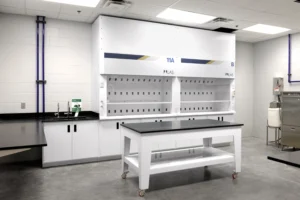
Advanced containment of toxic fumes
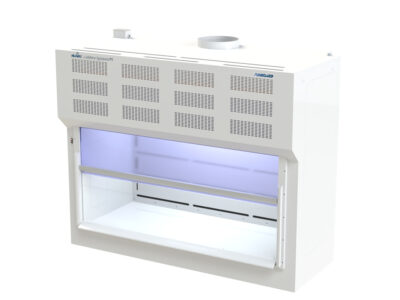
LabAire Systems manufactures a complete line of airflow containment devices designed for applications involving highly corrosive chemicals, toxic fumes, and other treatments not suitable for metallic exposure. Constructed with stress-relieved polypropylene, our fume hoods are ideal for wet labs and metal-free environments to effectively contain and exhaust corrosive chemicals, organic solvents and acidic materials.
Our cutting-edge fume hoods safely vent toxic fumes away from the work zone. We offer hoods equipped with a high-efficiency particulate air (HEPA) filtration system, ensuring optimal air quality within the enclosed workspace.
Optimal ventilation
Ideal face velocity
Superior performance
Advanced lab protection
Airflow in action
Our engineers created a simulation of airflow within a custom LAS fume hood. This video shows air velocity in feet per minute as it pulls from the work access opening and draws across the work surface toward the back of the hood. The fume hood operator is always protected. Our baffle design helps keep fumes within the hood from escaping through the sash.
Have questions about Fume Hoods?
When should I use a fume hood?
Chemical fume hoods safely vent toxic fumes and highly corrosive chemicals away from your lab environment. You need a hood if your work involves using any of the following.
- Chemicals with a National Fire Protection Association (NFPA) health rating of 3 or 4
- Toxic volatile materials such as chloroform or formaldehyde
- Flammable chemicals
- Carcinogens or particularly hazardous substances
- Procedures that may create an aerosol of a toxic substance
- Reactive or explosive materials or chemicals that may spatter
- Toxic gases, including NH3, CO, F2, Cl2, H2S and NO2
- Odorous materials, whether hazardous and non-hazardous
When should I use a polypropylene fume hood?
The primary purpose of a polypropylene hood is to avoid metal deterioration in highly corrosive environments. A standard hood may be used in the same applications, but the key advantage of a polypropylene hood is its resistance to corrosion.
What can I store in the hood?
Hoods are designed for procedural work and not storage of any kind within the work zone. Storing equipment, chemicals or other large objects may disrupt airflow and eliminate the hood’s intended functionality.
What if I need to store large pieces of equipment in the hood?
If you must store large equipment in the hood that can potentially block the rear baffle, raise the equipment off the surface of the hood. This allows for proper airflow to reach the back of the hood.
Why should I keep work away from the front of the hood?
When chemical vapors are near the front of the hood, they aren’t efficiently captured and can escape into the room. To maintain proper containment, chemicals should be kept at least 6 inches back from the front of the work zone.
What is face velocity?
Face velocity is the speed at which room air is drawn into the hood through the opening, or “face.” The face of the hood is the opening where air capture takes place. Face velocity is measured during performance testing at the factory and after installation and indicates the hood’s performance.
What factors affect vapor capture in a fume hood?
As you work at the hood, air is drawn in a laminar flow through the face of the hood. Air velocity is one of the factors determining how well vapors and particles are captured and exhausted from the hood work zone. Vapor capture is also affected by airfoils, hood shape, configuration, equipment inside the hood, and cross drafts from foot traffic, proximity to doors and room vents.
Why is 100 fpm used as the ideal face velocity?
An optimal face velocity falls between 80 and 120 linear feet per minute (fpm). At lower velocities, the hood may not capture and remove vapors at a sufficient rate. At higher velocities, airflow can become turbulent, producing eddies and backflows that hinder the rate of removal or cause vapors to escape. Often, the best measurement of hood effectiveness is through visualization with dry ice or other visible fumes released in the hood.
Is using flammable chemicals in a fume hood with lights inside safe?
Yes. The lights inside hoods are sealed to prevent flammable vapors and are considered “intrinsically safe.” This means all electrical components in new hoods are designed so that flammable vapors should not be a fire hazard.
However, if you use other electrical equipment or heating apparatus in the hood, they may pose a fire risk. Always ensure they are intrinsically safe, or use them outside the hood. Take care with all heating devices and flammable solvents. Avoid open flames, and carefully monitor the temperature of other heating elements.
What should I consider when selecting a standalone or “ductless” fume hood that doesn’t vent to the outside?
Filters used in ductless hoods are an important consideration. Hoods that do not vent outside the building rely on filters inside the cabinet. These filters remove vapors and toxins from the air inside the hood before discharging into the lab air. Filters do not completely capture all vapors, and some vapors can end up in the lab’s breathing air. Also, contaminants that build up on the filters can become a hazard. To maintain safety, it’s essential to establish a maintenance schedule to replace and dispose of filters, usually managed by a contractor.
Ready to find the perfect solution? Contact our expert team today.